
Friday, February 28, 2014


Thursday, February 27, 2014
Bush cyberczar: NSA created ‘the potential for a police state’
February 25, 2014 19:02
The former cyber advisor under President George W. Bush had some harsh words for the United States National Security Agency during an address in California on Monday: "get out of the business of fucking with encryption standards.”
That was the recommendation that famed cyberczar Richard Clarke made while speaking earlier this week at the at the Cloud Security Alliance summit in San Francisco.
Clarke, 63, served as a counterterrorism advisor for President Bill Clinton in the 1990s and later assisted his successor, Mr. Bush, as the special advisor on cybersecurity for that administration through 2003. Most recently, though, Clarke was assigned to a five-person panel assembled by Pres. Obama late last year that was tasked with assessing the NSA’s operations in the midst of ongoing and ever-damagingleaks disclosed by former intelligence contractor Edward Snowden. In December, that group suggested 46 changes for the Obama administration to consider in order rein in the secretive spy agency.
Speaking during Monday’s conference, however, Clarke opened up about some of the more personal suggestions he has for the NSA, and even some insight about what the future may have in store for the agency if they continue to collect intelligence from seemingly all corners of the Earth.
"In terms of collecting intelligence, they are very good. Far better than you could imagine," Clarke said."But they have created, with the growth of technologies, the potential for a police state."
"If you're not specific, an agency that bugs phones is going to bug phones," he added, according to the Tech Target blog, Search Security. "The NSA is an organization that's like a hammer, and everything looks like a nail."
Even if the NSA scales back such hacking operations in the future as Pres. Obama suggested and limits who the US targets and how, Clarke said during Monday’s address that another type of interference favored by the agency — influencing and intentionally degrading encryption standards — need to be scraped.
Since June, those Snowden leaks have exposed an array of previously covert NSA operations, including programs that put the emails of foreign leaders and phone data pertaining to millions of Americans into the hands of the US government. According to Clarke, though, the NSA’s handling of encryption standards — as exposed by Snowden — has serious repercussions.
In September, leaked documents courtesy of Mr. Snowden showed the NSA has invested millions of dollars to be able to decrypt “large amounts” of supposedly secure data, an operation that spies at Britain’s GCHQ called “an aggressive, multipronged effort to break widely used Internet encryption technologies.” Then in December, further Snowden documents showed that RSA, a private company considered a staple of the computer security industry, had secretly entered into a $10 million contract with the NSA to create a government-friendly “backdoor” in its products.
Because of the NSA’s efforts, Clarke said during Monday’s event, “the trust in encryption has been greatly eroded.”
“The encryption standards need to be trusted,” he said, according to Infosecurity Magazine. “The US government has to get out of the business of fucking around with encryption standards.”
“We need to rebuild the trust in encryption; we need to have the US government forced some way into ensuring this happens,” he said.
When Clarke and four other Obama-appointed experts weighed in on the NSA’s programs for the report released in December, the group said they were “unaware of any vulnerability created by the US government in generally available commercial software that puts users at risk of criminal hackers or foreign governments decrypting their data. Moreover, it appears that in the vast majority of generally used, commercially available encryption software, there is no vulnerability, or ‘backdoor,’ that makes it possible for the US government or anyone else to achieve unauthorized access.”
As part of the group’s recommendations, they advised that the NSA “not engineer vulnerabilities into the encryption algorithms that guard global commerce” and “not demand changes in any product by any vendor for the purpose of undermining the security or integrity of the product, or to ease NSA’s clandestine collection of information by users of the product.”
http://rt.com/usa/clarke-summit-encryption-standards-711/
Wednesday, February 26, 2014
Gold price rigging fears put investors on alert
February 23, 2014 8:19 am
By Madison Marriage
Global gold prices may have been manipulated on 50 per cent of occasions between January 2010 and December 2013, according to analysis by Fideres, a consultancy.
The findings come amid aprobe by German and UK regulatorsinto alleged manipulation of the gold price, which is set twice a day byDeutsche Bank,HSBC, Barclays,Bank of Nova ScotiaandSociété Généralein a process known as the “London gold fixing”.
Fideres’ research found the gold price frequently climbs (or falls) once a twice-daily conference call between the five banks begins, peaks (or troughs) almost exactly as the call ends and then experiences a sharp reversal, a pattern it alleged may be evidence of “collusive behaviour”.
“[This] is indicative of panel banks pushing the gold price upwards on the basis of a strategy that was likely predetermined before the start of the call in order to benefit their existing positions or pending orders,” Fideres concluded.
“The behaviour of the gold price is very suspicious in 50 per cent of cases. This is not something you would expect to see if you take into account normal market factors,“ said Alberto Thomas, a partner at Fideres.
Alasdair Macleod, head of research at GoldMoney, a dealer in physical gold, added: “When the banks fix the price, the advantage they have is that they know what orders they have in the pocket. There is a possibility that they are gaming the system.”
Pension funds, hedge funds, commodity trading advisers and futures traders are most likely to have suffered losses as a result, according to Mr Thomas, who said that many of these groups were “definitely ready” to file lawsuits.
Daniel Brockett, a partner at law firm Quinn Emanuel, also said he had spoken to several investors concerned about potential losses.
“It is fair to say that economic work suggests there are certain days when [the five banks] are not only tipping their clients off, but also colluding with one another,” he said.
Matt Johnson, head of distribution at ETF Securities, one of the largest providers of exchange traded products, said that if gold price collusion is proven, “investors in products with an expiry price based around the fixing could have been badly impacted”.
Gregory Asciolla, a partner at Labaton Sucharow, a US law firm, added: “There are certainly good reasons for investors to be concerned. They are paying close attention to this and if the investigations go somewhere, it would not surprise me if there were lawsuits filed around the world.”
All five banks declined to comment on the findings, which come amid growing regulatory scrutiny of gold and precious metal benchmarks.
BaFin, the German regulator, has launched an investigation into gold-price manipulation and demanded documents from Deutsche Bank. The bank last month decided toend its role in gold and silver pricing. The UK’s Financial Conduct Authority is also examining how the price of gold and other precious metals is set as part of a wider probe into benchmark manipulation following findings of wrongdoing with respect toLiborand similarallegations with respect to the foreign exchange market.
The US Commodity Futures Trading Commission has reportedly held private meetings to discuss gold manipulation, but declined to confirm or deny that an investigation was ongoing.
Tuesday, February 25, 2014
Vayer says he would like to believe Froome, but doesn’t have enough information
- By Andrew Hood
Just when it seemed like things had gone quiet, former Festina trainer Antoine Vayer lit up Twitter last weekend with pointed comments about Chris Froome’s recent performance en route to winning the Tour of Oman.
Froome's power output ~6.70 W/kg at Oman Tour, 9 mn for "GREEN mountain's" It's a fucking RED ridiculous performance. Bullshit, joke.
— Antoine VAYER (@festinaboy) February 22, 2014
It was trademark Vayer, who shoots from the hip and thrives on a being a thorn in the side of cycling’s establishment. He had no way of proving those were indeed Froome’s accurate power numbers, but it didn’t matter.
Last summer, Vayer wrote the provocative study called “Not Normal,” in which he broke down 21 top performances over the past 30 years, comparing and ranking power numbers based on a credibility scale.
Vayer’s comments, coupled with others, helped push the power numbers debate to the center of the conversation during last year’s Tour de France.
Some say he’s crackpot at best, vindictive and ill informed at worse. Regardless of what his detractors say, he remains one of the strongest voices of skepticism within cycling.
While others have bought into the notion that cycling has indeed changed, Vayer remains incredulous that the marginal gains of “new cycling” could equate to the superlative performances of the EPO era.
VeloNews caught up with Vayer as the peloton rolls into the 2014 season to gauge his mood. He’s still skeptical, but admitted he sees a glimmer of hope.
VeloNews: There is talk of a lot of changes within the sport, but you remain skeptical. Coming into 2014, how do you view the peloton?
Antoine Vayer: There are two things: doping and true sport. Today, there are more and more clean riders. I was recently at some races in the south of France, and I have close contact with many riders, and they came to me to say you can stay pure and still have good results. Many riders are fed up with the doping culture. It does not concern them. Today, the professionals train better and more, and they can begin the season with very good results. Without a doubt, there are more good pure riders at the top level. I remember back in the 1990s, nobody really trained. Everyone was quite stupid. There was no science, no coaching, no training camps, no warmups before a time trial. Now everyone is doing that. The level has increased.
Antoine Vayer: There are two things: doping and true sport. Today, there are more and more clean riders. I was recently at some races in the south of France, and I have close contact with many riders, and they came to me to say you can stay pure and still have good results. Many riders are fed up with the doping culture. It does not concern them. Today, the professionals train better and more, and they can begin the season with very good results. Without a doubt, there are more good pure riders at the top level. I remember back in the 1990s, nobody really trained. Everyone was quite stupid. There was no science, no coaching, no training camps, no warmups before a time trial. Now everyone is doing that. The level has increased.
VN: Fair enough, but you’re obviously not convinced.
AV: The problem still is at the very high level of the sport, according to me, there are still cheaters and liars. The goal is to reduce the difference between the good, pure riders and the cheaters. We are close, but not yet there.
AV: The problem still is at the very high level of the sport, according to me, there are still cheaters and liars. The goal is to reduce the difference between the good, pure riders and the cheaters. We are close, but not yet there.
VN: We’re already seeing a lot of top riders with some strong early-season performances. What do you take from that?
AV: Normally, when you look at a season, say from February to the Tour, a top rider can improve by 5-15 percent. This year some are starting at incredibly high levels. [Alejandro] Valverde, [Chris] Froome, and some others, they are very good. They could race the Tour de France right now. If they increase even more, it will be fantastic. They will really be flying. Before, people would train with a peak of form; today they are already at a high level. That makes you think a lot.
AV: Normally, when you look at a season, say from February to the Tour, a top rider can improve by 5-15 percent. This year some are starting at incredibly high levels. [Alejandro] Valverde, [Chris] Froome, and some others, they are very good. They could race the Tour de France right now. If they increase even more, it will be fantastic. They will really be flying. Before, people would train with a peak of form; today they are already at a high level. That makes you think a lot.
VN: Some argue that training methods of have changed, that riders can build good form early and hold it, such as Bradley Wiggins and Chris Froome, who raced and won from February to July.
AV: They win everything! They have no peak form. Froome has the same form in Oman now as he did at the end of last year’s Tour. I cannot imagine he will be in better shape in July. If he is [laughs], all the riders should not even bother to show up.
AV: They win everything! They have no peak form. Froome has the same form in Oman now as he did at the end of last year’s Tour. I cannot imagine he will be in better shape in July. If he is [laughs], all the riders should not even bother to show up.
VN: You posted a Twitter message this week that cast doubt on Froome. Do you not believe his power numbers are credible?
AV: Chris is one of the reasons why I have many doubts. We can begin to hope to believe, but with Chris, there is too much doubt. As long as we do not have proof that he is OK, that he is not cheating, I will have too much doubt.
AV: Chris is one of the reasons why I have many doubts. We can begin to hope to believe, but with Chris, there is too much doubt. As long as we do not have proof that he is OK, that he is not cheating, I will have too much doubt.
VN: Sky and Froome have been quite open, but that’s not enough for you?
AV: I would like to be convinced that Froome is exceptional. For me, what he does is unbelievable. He has not given proof, except saying that, “I train well, blah, blah, blah.” That is not enough.
AV: I would like to be convinced that Froome is exceptional. For me, what he does is unbelievable. He has not given proof, except saying that, “I train well, blah, blah, blah.” That is not enough.
VN: What would convince you? Have you ever tried to get more evidence directly from Sky to convince you?
AV: As a matter of fact, I met with Dave Brailsford and Tim Kerrison [Sky's general manager and top coach] after the time trial in Saint Malo last year, when Froome was second. I was very surprised that they met with me. We spoke for nearly two hours that evening after the race. All they did was speak, and for them to say to me that he was exceptional was not enough. I said, “I have nothing against you, but can you give me physical evidence?” They said, “No, we are the best, we train the best,” and that was it. For me, it was not enough.
AV: As a matter of fact, I met with Dave Brailsford and Tim Kerrison [Sky's general manager and top coach] after the time trial in Saint Malo last year, when Froome was second. I was very surprised that they met with me. We spoke for nearly two hours that evening after the race. All they did was speak, and for them to say to me that he was exceptional was not enough. I said, “I have nothing against you, but can you give me physical evidence?” They said, “No, we are the best, we train the best,” and that was it. For me, it was not enough.
VN: Did you ask to see Froome’s power numbers or other data that might have convinced you?
AV: They showed me nothing. No official power numbers, nothing. One thing that struck me; I remember when I was at the Tour in 2000, and in the hotel of the yellow jersey, there were 500 people milling around the hotel, watching the mechanics, waiting to see the riders. That night with Team Sky, there was no public. No one. Not one single fan. For me, that was quite a shock. It’s a new phenomenon in cycling. We have races, but there is no public. Like races in China, Dubai, even in Europe, there is no public at all.
AV: They showed me nothing. No official power numbers, nothing. One thing that struck me; I remember when I was at the Tour in 2000, and in the hotel of the yellow jersey, there were 500 people milling around the hotel, watching the mechanics, waiting to see the riders. That night with Team Sky, there was no public. No one. Not one single fan. For me, that was quite a shock. It’s a new phenomenon in cycling. We have races, but there is no public. Like races in China, Dubai, even in Europe, there is no public at all.
VN: To defend Froome, Sky insists that their power numbers are private, but they have revealed other information. What would be enough to satisfy your doubts?
AV: Well, to speak of data, things like the biological passport is not enough. They should add other tests to measure the physical ability of a rider, like VO2 max, a Cybex test, there are plenty of ways to measure someone’s capability, to know if they are OK. But no one wants to share that information.
AV: Well, to speak of data, things like the biological passport is not enough. They should add other tests to measure the physical ability of a rider, like VO2 max, a Cybex test, there are plenty of ways to measure someone’s capability, to know if they are OK. But no one wants to share that information.
VN: You speak about how more clean riders can post results. In your view, what percentage of the peloton is clean? Back in the 1990s, we now know that just about everyone was doping. What’s your view of today’s peloton?
AV: Those who want to race clean can do it and post results. Riders like Dan Martin winning Liège-Bastogne-Liège is a very good sign. He is a rider we can believe. That’s very encouraging. Back in 1998, there was one: [Christophe] Bassons. Today there are many Bassons. A clean rider is no longer the exception. There is talk of a change of culture, yet some people I speak to inside the peloton will tell me there are still some people who are “full gas.” What percentage is that? It’s hard to say. It’s better now for clean riders, but still many riders are “full gas.” What is sure is that if Bassons raced today, he would now have many good results.
AV: Those who want to race clean can do it and post results. Riders like Dan Martin winning Liège-Bastogne-Liège is a very good sign. He is a rider we can believe. That’s very encouraging. Back in 1998, there was one: [Christophe] Bassons. Today there are many Bassons. A clean rider is no longer the exception. There is talk of a change of culture, yet some people I speak to inside the peloton will tell me there are still some people who are “full gas.” What percentage is that? It’s hard to say. It’s better now for clean riders, but still many riders are “full gas.” What is sure is that if Bassons raced today, he would now have many good results.
VN: You’re basing that assumption on how you’re interpreting the power numbers of the top riders?
AV: At the top of the sport, there are still some cheaters and dopers, without a doubt. Measuring their performances is a good way to see that. What was interesting is that during last year’s Tour, I met many people who are doing the same work as me. We all make calculations, and we all agree that the top performances are not normal. There is not one of them who say that it’s possible. There are still too many riders that are not normal.
AV: At the top of the sport, there are still some cheaters and dopers, without a doubt. Measuring their performances is a good way to see that. What was interesting is that during last year’s Tour, I met many people who are doing the same work as me. We all make calculations, and we all agree that the top performances are not normal. There is not one of them who say that it’s possible. There are still too many riders that are not normal.
VN: Some have suggested that your power calculations are off, that they are founded on incomplete information, or that they are overly simplistic. How do you respond to that?
AAV: They are accurate. There are many people making these calculations across the world, and we all come to a similar conclusion. I also have friends within the peloton, riders who have reached out to me, and who help me with my calculations. For example, to calculate Froome’s numbers in Oman, a rider who finished very close to him gave us his power meter files. So that way, we can make direct and indirect calculations.
AAV: They are accurate. There are many people making these calculations across the world, and we all come to a similar conclusion. I also have friends within the peloton, riders who have reached out to me, and who help me with my calculations. For example, to calculate Froome’s numbers in Oman, a rider who finished very close to him gave us his power meter files. So that way, we can make direct and indirect calculations.
VN: But there must be some margin of error?
AV: They are very accurate. They can be off by one percent. People who say that our numbers are off do not understand what we are doing, or they say it to make us lose credibility. The calculations are accurate. Believe me, I would love to see a Tour raced at 10 watts less. That would be a fantastic Tour!
AV: They are very accurate. They can be off by one percent. People who say that our numbers are off do not understand what we are doing, or they say it to make us lose credibility. The calculations are accurate. Believe me, I would love to see a Tour raced at 10 watts less. That would be a fantastic Tour!
VN: Young riders coming into the sport, such as Andrew Talansky and Taylor Phinney, have suggested they have never been approached about doping, and say that no one has ever encouraged them to dope. What do you take from those kinds of comments?
AV: I don’t know them personally, but what they are saying is quite different from what the dopers and cheaters used to say. They have nothing to hide, and you can sense that. I feel good about what they say and how they race. If Phinney were clean, even if he is in top form and at a peak, would he ever be able to ride at the front of the Tour? No! He would have to be like [Miguel] Indurain. I don’t think a rider as big as Phinney can ever win the Tour, unless he did the things Indurain did.
AV: I don’t know them personally, but what they are saying is quite different from what the dopers and cheaters used to say. They have nothing to hide, and you can sense that. I feel good about what they say and how they race. If Phinney were clean, even if he is in top form and at a peak, would he ever be able to ride at the front of the Tour? No! He would have to be like [Miguel] Indurain. I don’t think a rider as big as Phinney can ever win the Tour, unless he did the things Indurain did.
VN: What kind of contacts do you have in the peloton today?
AV: The best experts on doping are the riders and former riders who are now sport directors. They were part of this culture of lying and cheating. They are the experts. They can look at a rider and they can tell immediately if something is not right, by their pedaling style, how they’re breathing. What is good now is that the cycling public is now very well informed. People are not as gullible as before. Today, if a rider like Phinney pushed 450 watts for 40 minutes up a climb like La Plagne after five hours of racing, they would scream, “who is this guy?” The public doesn’t have to listen to the journalists anymore. They can make up their own minds, and say this is bullshit. And I would like to explain performances like Froome’s, but I cannot explain it. They must give me more evidence before I can believe them.
AV: The best experts on doping are the riders and former riders who are now sport directors. They were part of this culture of lying and cheating. They are the experts. They can look at a rider and they can tell immediately if something is not right, by their pedaling style, how they’re breathing. What is good now is that the cycling public is now very well informed. People are not as gullible as before. Today, if a rider like Phinney pushed 450 watts for 40 minutes up a climb like La Plagne after five hours of racing, they would scream, “who is this guy?” The public doesn’t have to listen to the journalists anymore. They can make up their own minds, and say this is bullshit. And I would like to explain performances like Froome’s, but I cannot explain it. They must give me more evidence before I can believe them.
VN: Changing topic, what is your view of the efforts by the UCI to investigate doping within the sport?
AV: When we met in 2012, we called for a “truth and reconciliation” within the sport. This effort [CIRC] is not truth and reconciliation. I don’t think it’s enough. Maybe going further would be a Pandora’s box. We will see. I want to help. I believe we should help [UCI president Brian] Cookson because he has the will to change things. We still need more pressure on riders and managers to change.
AV: When we met in 2012, we called for a “truth and reconciliation” within the sport. This effort [CIRC] is not truth and reconciliation. I don’t think it’s enough. Maybe going further would be a Pandora’s box. We will see. I want to help. I believe we should help [UCI president Brian] Cookson because he has the will to change things. We still need more pressure on riders and managers to change.
VN: Many are hopeful Lance Armstrong will step forward, do you expect his cooperation?
AV: I think Armstrong would say many things to the right person. What he lacks is confidence in the process. Armstrong, like all the dopers and cheaters, needs to be involved in the process. They are the experts. Imagine if Armstrong put the same energy and focus into cleaning up cycling as he did into winning the Tour while doping? That would be something! Doping is the problem that must be solved in cycling. It can be solved quite quickly if we have the will. The problem is always money.
AV: I think Armstrong would say many things to the right person. What he lacks is confidence in the process. Armstrong, like all the dopers and cheaters, needs to be involved in the process. They are the experts. Imagine if Armstrong put the same energy and focus into cleaning up cycling as he did into winning the Tour while doping? That would be something! Doping is the problem that must be solved in cycling. It can be solved quite quickly if we have the will. The problem is always money.
VN: From listening to you, it sounds like you remain skeptical, but you also see reason for encouragement. Is that accurate?
AV: I see a lot of reasons to be optimistic. If everyone has the same will to fight doping, it could end very fast. All the people who do not want to admit that, they must be out of the sport. And all the journalists who say that cycling was still beautiful even when the peloton was doped, they must be out as well. The sport has come a long way in 20 years. Some riders appreciate me, but to some people, I am still the devil.
AV: I see a lot of reasons to be optimistic. If everyone has the same will to fight doping, it could end very fast. All the people who do not want to admit that, they must be out of the sport. And all the journalists who say that cycling was still beautiful even when the peloton was doped, they must be out as well. The sport has come a long way in 20 years. Some riders appreciate me, but to some people, I am still the devil.
VN: Is there a perception gap, between the headlines from the EPO era and today’s peloton, even if you remain skeptical?
AV: There is. Last year, I wrote this magazine called “Not Normal,” and someday I would like to write another magazine, with 21 reasons to believe in the Tour. I would like to write something like that, to convince the public they can follow the sport, they can believe the performances, that their kids should race their bikes, that riders can compete at a high level. I would like to say Froome is clean. Believe me, I would like to write poetry about the beauty of cycling rather than write about power numbers! But I am still waiting for that moment.
Monday, February 24, 2014
Another Banker Dies
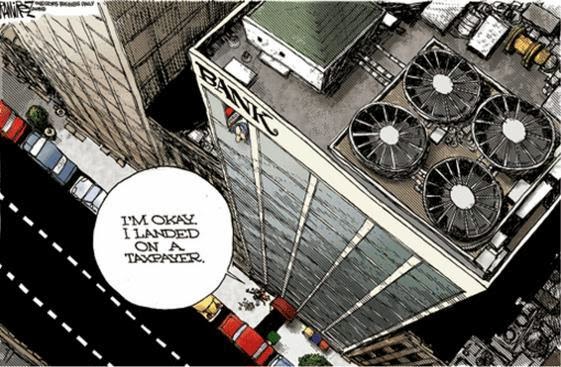
Which brings the total number of recent banker deaths to 9 (via Intellihub):
1 – William Broeksmit, 58-year-old former senior executive at Deutsche Bank AG, was found dead in his home after an apparent suicide in South Kensington in central London, on January 26th.
2- Karl Slym, 51 year old Tata Motors managing director Karl Slym, was found dead on the fourth floor of the Shangri-La hotel in Bangkok on January 27th.
3 – Gabriel Magee, a 39-year-old JP Morgan employee, died after falling from the roof of the JP Morgan European headquarters in London on January 27th.
4 – Mike Dueker, 50-year-old chief economist of a US investment bank was found dead close to the Tacoma Narrows Bridge in Washington State.
5 – Richard Talley, the 57 year old founder of American Title Services in Centennial, Colorado, was found dead earlier this month after apparently shooting himself with a nail gun.
6 -Tim Dickenson, a U.K.-based communications director at Swiss Re AG, also died last month, however the circumstances surrounding his death are still unknown.
7 – Ryan Henry Crane, a 37 year old executive at JP Morgan died in an alleged suicide just a few weeks ago. No details have been released about his death aside from this small obituary announcement at the Stamford Daily Voice.
8 - Li Junjie, 33-year-old banker in Hong Kong jumped from the JP Morgan HQ in Hong Kong this week.
http://www.zerohedge.com/news/2014-02-24/another-successful-banker-found-dead
Sunday, February 23, 2014
Subscribe to:
Posts (Atom)