Saturday, September 22, 2012


Thursday, September 20, 2012

Tuesday, September 18, 2012
@JamesGRickards - With U.S., European Monetary Easing Announcements, Is China Next?
James Rickards is a hedge fund manager in New York City and the author of Currency Wars: The Making of the Next Global Crisis from Portfolio/Penguin. Follow him on Twitter at @JamesGRickards.
The past three weeks have been the most momentous of the year for financial markets.
On August 30, Federal Reserve Chairman Ben Bernanke offered broad hints that more money printing, so-called quantitative easing or "QE," was coming soon. The earlier quantitative easing programs known as QE1 and QE2 had come and gone. Markets were looking for a new dose of easy money. Bernanke offered a detailed case that concluded money printing was having a beneficial impact on the economy and employment and that another round would have some additional positive effects.
On September 6, the European Central Bank announced its own form of monetary ease. This program was technically different from quantitative easing. The European Central Bank would print new money to buy government bonds exactly like the Federal Reserve. However, the European Central Bank would then remove the newly printed money by offering deposits to the banks that were selling the bonds. The net effect of the purchases and the deposits would be that no new money would be created. But, the operation would put a lid on European sovereign bond interest rates and provide relief for that beleaguered sector. European stocks and bonds and the euro all rallied on the news.
September 7 saw the release of a worse-than-expected employment report in the United States. This all but guaranteed more easing by the Fed because lack of progress in the jobs market was one rationale the Fed gave for new money printing. As if on cue, the Fed announced new quantitative easing on September 13.
This new program was different from QE1 and QE2 in one important respect. The prior programs had involved purchases of specific types of securities in specific amounts to be completed in defined time periods. The new program has no limits. The Fed can buy unlimited amounts of mortgages, Treasuries or other securities for as long as they want. The idea is to keep printing money until the Fed's goals on ,employment are met. The new term of art for this unlimited money printing was "open-ended." U.S. stocks and gold rallied on the Fed's announcement.
But there was still one dog that had not yet barked. While the Fed and European Central Bank were making a splash, the third leg of the global economic stool, China, was strangely silent. In early September, there were some Chinese announcements about new infrastructure projects, but these had already been expected by the markets and had more to do with fiscal stimulus than monetary ease. The world was still waiting for a third easing announcement from the People's Bank of China following those by the European Central Bank and the Fed. China is in the midst of a once every 10 years hand-off of power from President Hu Jintao to the expected new President Xi Jinping. In such a delicate environment, the People's Bank of China might be expected to be more cautious than usual.
On Thursday, September 13, even as the Fed was making its easing announcements in Washington, People's Bank of China officials met secretly in Shanghai with members of its private advisory board to get market input regarding its policies. The advisers told the People's Bank of China that interest rate cuts were having little or no favorable impact on business conditions in China. This was because of the short maturities of the funds the People's Bank of China was making available to the commercial banks. Banks could earn 3 percentage point spreads by borrowing cheaply from People's Bank of China and lending to commercial borrowers. The problem was there was no assurance that the low funding rates would remain low over the life of the loans. The People's Bank of China had never offered the "extended period" language that the Fed had offered banks in the United States. Our banks could borrow short and lend long with confidence that short-term rates would not spike before the loans were repaid. Chinese banks had no such assurance and therefore would not make the needed loans.
The private advisers told the People's Bank of China that the best way to get commercial bank lending and money supply growing again in China was to lower bank reserve requirements and loan-to-deposit ratio requirements. Both of these moves would allow Chinese banks to make more loans using the same capital base they had already. This increased leverage would increase returns on equity for the banks and offset some of the risk of borrowing short and lending long.
It is highly likely that the People's Bank of China will follow the advice provided to them. Look for the People's Bank of China to cut either the reserve ratio or the loan-to-deposit ratio, or both, in the next 30 days. This ease, along with ramped up infrastructure spending, should give the Chinese economy the boost it needs to grow above expectations through the end of 2012 and into 2013.
With important elections looming in Germany, Italy, and the United States, and a leadership change in China, it is fortunate for the power elites in the three major currency zones that the their central banks have seen fit to provide monetary ease in a timely and seemingly coordinated way. Call it three easy pieces. Things will not be so easy for the citizens in all three areas when they suffer the inflation that will eventually follow.
http://www.usnews.com/opinion/blogs/economic-intelligence/2012/09/17/with-us-european-monetary-easing-announcements-is-china-next
Monday, September 17, 2012
Federal Reserve FB
One day after the Federal Reserve announced a new open-ended mortgage-bond buying program–a third round of what’s known as quantitative easing, or QE3–theFederal Reserve Bank of San Francisco posed a question on its Facebook FB -1.72% page: “What effect do you think QE3 will have on the U.S. economy?”

h/t zerohedge and WSJ
http://blogs.wsj.com/economics/2012/09/17/qe3-not-getting-a-lot-of-likes-on-facebook/?mod=WSJBlog&utm_source=twitterfeed&utm_medium=twitter
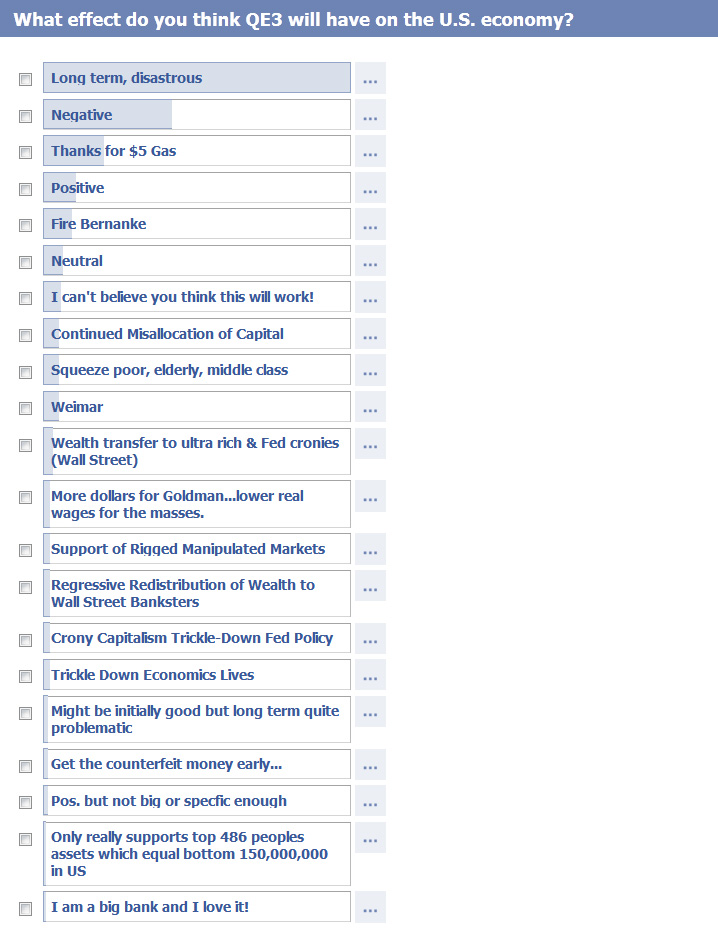
h/t zerohedge and WSJ
http://blogs.wsj.com/economics/2012/09/17/qe3-not-getting-a-lot-of-likes-on-facebook/?mod=WSJBlog&utm_source=twitterfeed&utm_medium=twitter
Sunday, September 16, 2012
War Machine Readies
|
Friday, September 14, 2012
The Bernank buys MBS as the Great De-lever Continues
Two charts tell it all...


ht...Ed Steer
...and...Miners bottom in...

ht...Jack Damn


ht...Ed Steer
...and...Miners bottom in...

ht...Jack Damn
Mortgage-Backed Securities
Mortgage-backed securities (MBS) are debt obligations that represent claims to the cash flows from pools of mortgage loans, most commonly on residential property. Mortgage loans are purchased from banks, mortgage companies, and other originators and then assembled into pools by a governmental, quasi-governmental, or private entity. The entity then issues securities that represent claims on the principal and interest payments made by borrowers on the loans in the pool, a process known as securitization.
Most MBSs are issued by the Government National Mortgage Association (Ginnie Mae), a U.S. government agency, or the Federal National Mortgage Association (Fannie Mae) and the Federal Home Loan Mortgage Corporation (Freddie Mac), U.S. government-sponsored enterprises. Ginnie Mae, backed by the full faith and credit of the U.S. government, guarantees that investors receive timely payments. Fannie Mae and Freddie Mac also provide certain guarantees and, while not backed by the full faith and credit of the U.S. government, have special authority to borrow from the U.S. Treasury. Some private institutions, such as brokerage firms, banks, and homebuilders, also securitize mortgages, known as "private-label" mortgage securities.
Mortgage-backed securities exhibit a variety of structures. The most basic types are pass-through participation certificates, which entitle the holder to a pro-rata share of all principal and interest payments made on the pool of loan assets. More complicated MBSs, known as collaterized mortgage obligations or mortgage derivatives, may be designed to protect investors from or expose investors to various types of risk. An important risk with regard to residential mortgages involves prepayments, typically because homeowners refinance when interest rates fall. Absent protection, such prepayments would return principal to investors precisely when their options for reinvesting those funds may be relatively unattractive.
Thursday, September 13, 2012
Sentinel ruling may hurt MF Global clients (and you, too)
CHICAGO |
(Reuters) - A ruling in the case of failed futuresbrokerage Sentinel Management Group could make it more difficult for customers to recoup money lost in the much larger collapse of MF Global, according to Sentinel's bankruptcy trustee.
A federal appeals court on Thursday upheld a ruling that puts Bank of New York Mellon ahead of former customers of Sentinel in the line of those seeking the return of money lost in the 2007 failure of the suburban Chicago-based futures broker.
The appeals court affirmed an earlier district court ruling that the bank had a "secured position" on a $312 million loan it gave to Sentinel, which turned out to have been secured by customer money.
Futures brokers are required to keep customers' funds in dedicated accounts to protect them from being used for anything other than client business.
However, Thursday's ruling suggests that brokerages can use customer funds to pay off other creditors, Sentinel trustee Fred Grede told Reuters.
"I don't think that's what the Commodity Futures Trading Commission had in mind" with its requirement that brokers keep customer money separate from their own, he said.
"It does not bode well for the protection of customer funds."
Worse, Grede said, is that the ruling suggests that a brokerage that allows customer money to be mixed with its own is not necessarily committing fraud.
That may raise the bar for proving that MF Global Holdings Ltd, under then-CEO Jon Corzine, misused customer funds as it scrambled to meet margin calls to back bets on European debt in the brokerage's final days. A $1.6 billion customer shortfall remains.
Corzine has said he did not know about the transfer of any customer money.
"I'm sure Mr. Corzine's attorneys will get ahold of this ruling and use it for all it's worth," Grede said.
A lawyer for Corzine, who has not been charged with any crimes, did not immediately respond to a request for comment.
CORZINE MAY STILL FACE SCRUTINY
CME Group Executive Chairman Terrence Duffy, whose firm was MF Global's frontline regulator, has said MF Global made unlawful transfers of customer money to plug its own liquidity needs.
James Koutoulas, head of the Commodity Customer Coalition, which has been an advocate for MF Global clients, said Corzine could still face scrutiny for the transfers.
The Sentinel ruling is "not an end-all-be-all acquittal for Corzine," he said.
Sentinel allegedly pledged hundreds of millions of dollars in customer assets to secure an overnight loan at Bank of New York Mellon, leaving the bank in a secured position but Sentinel's customers out millions.
Customer funds were allegedly moved from the protected accounts to other accounts so they could be used as collateral for loans to Sentinel's own trading operations.
The appeals court said that "perhaps the bank should have known that Sentinel violated segregation requirements" but agreed with the district court's earlier ruling that "such a lack of care does not rise to the level of the egregious misconduct" needed to reprioritize a claim.
"That Sentinel failed to keep client funds properly segregated is not, on its own, sufficient to rule as a matter of law that Sentinel acted ‘with actual intent to hinder, delay, or defraud' its customers," U.S. Circuit Judge John D. Tinder wrote in the ruling.
The decision was a blow for Grede, who had sought to strip Bank of New York Mellon of its secured position.
Sentinel, whose customers are missing about $600 million, largely managed money for other futures brokers, delivering outsized returns that, Grede says, were juiced up by improperly using customer money to secure loans that went to fund risky trades.
The scheme unraveled when the credit crisis hit in the summer of 2007.
(Additional reporting by Jonathan Stempel in New York; Editing by Gary Hill and Phil Berlowitz)
Subscribe to:
Posts (Atom)